
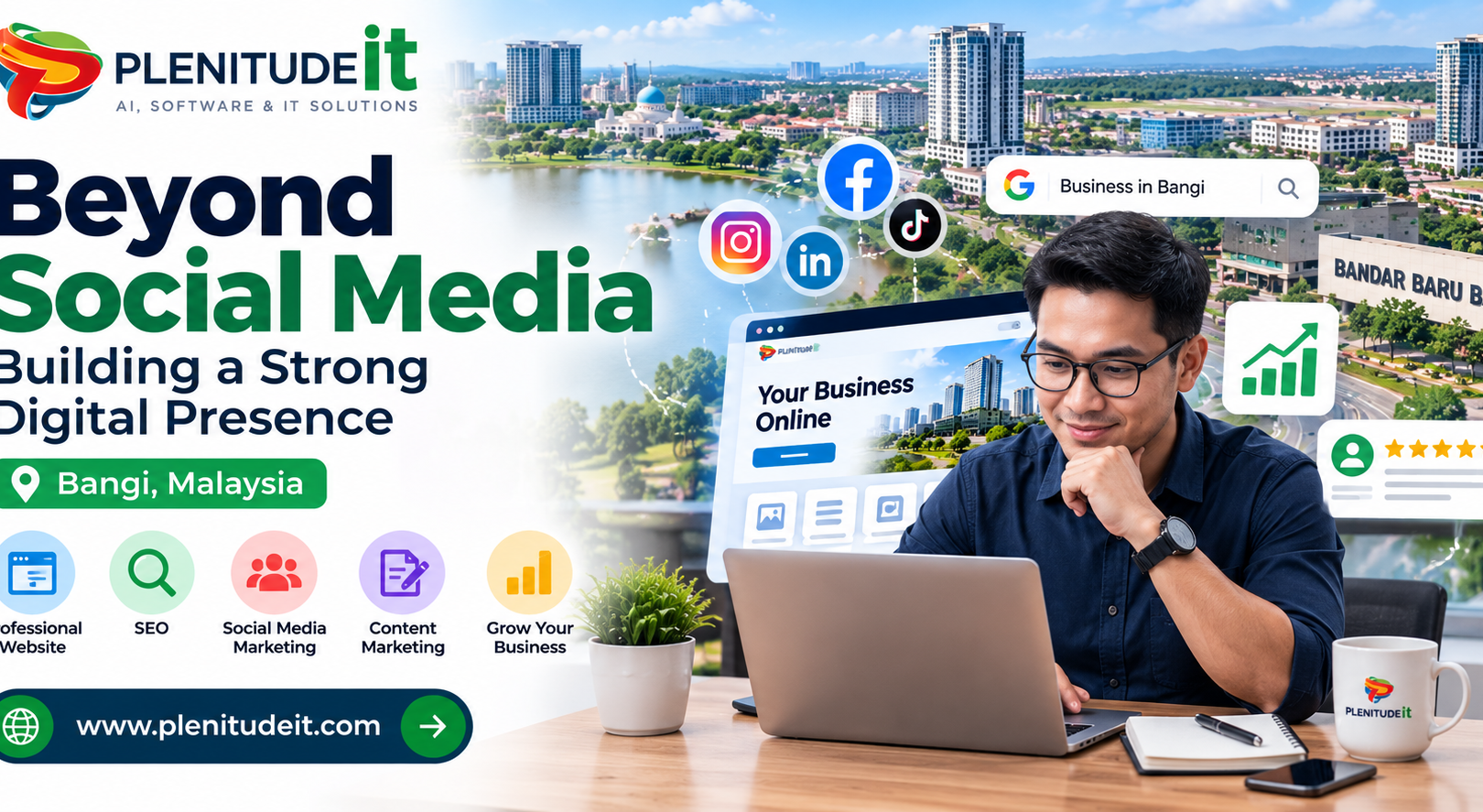
Beyond Social Media: Building a Strong Digital Presence for Bangi Businesses
Social media has become an important part of how businesses communicate with customers. From sharing product updates to announcing promotions, platforms such as Facebook, Instagram, LinkedIn and TikTok give businesses opportunities to connect with their audiences.
However, social media alone is not a complete digital strategy.
A business may have an active social media profile and regularly publish posts but still struggle to generate enquiries, attract relevant website visitors or convert online interest into sales. In many cases, the missing piece is a connected digital presence that brings together a professional website, search engine optimisation (SEO), useful content, social media and clear customer journeys.
For businesses in Bangi, Selangor, building this presence can help customers understand what the business offers, evaluate its credibility and take the next step when they are ready.
Whether you operate a retail shop, professional service, education business, restaurant, technology company or growing small business, your online presence should work together to support your business objectives.
In this guide, we explore how Bangi businesses can move beyond social media and develop a more effective digital strategy.
1. Why Social Media Alone May Not Be Enough
Social media is useful for brand awareness, engagement, community building and communicating with existing customers. It can also introduce your products and services to people who may not have discovered your business otherwise.
However, depending entirely on social media has limitations.
Your reach can change
The number of people who see your posts can vary according to platform algorithms, audience activity, competition and the type of content you publish. Even a business with an established following may not reach every potential customer with each post.
Customers may need more information
A short social media post cannot always explain your services, pricing approach, process, experience, frequently asked questions and other details customers need before making a decision.
A well-structured website gives you space to provide this information in a clear and organised way.
Search visibility is a separate opportunity
Some potential customers discover businesses through social media. Others search Google for a particular service, compare providers or look for solutions to a specific problem.
If your business has no useful website content, you may miss opportunities to reach people who are actively researching what you offer.
Turning interest into enquiries requires planning
A social media post might attract attention without generating a meaningful business result. Customers need a clear next step, such as viewing a service page, requesting a quotation, booking an appointment or contacting your team.
The goal is not to stop using social media. It is to make social media one part of a broader digital presence.
2. Build a Professional Website That Represents Your Business
Your website can serve as the central destination for your digital marketing activities. Social media posts, search results, email campaigns and online directories can direct interested customers to relevant information on your site.
For this reason, a website should do more than display your company name and contact details.
It should explain what you offer, who you help and how potential customers can take the next step.
Create dedicated service pages
If your business offers several services, consider giving each important service its own page. This allows you to explain the benefits, process, common questions and relevant information in greater detail.
For example, a professional service business in Bangi might need separate pages for consulting, training and implementation. An online retailer may need clear product categories, product descriptions and delivery information.
Organising information this way helps visitors find what they need without searching through a single crowded page.
Make the website mobile-friendly
Customers may discover your business while commuting, shopping or browsing on their phones. Your website should remain easy to use across different screen sizes.
Check that:
- Text is readable without unnecessary zooming.
- Menus are simple to navigate.
- Buttons and links are easy to tap.
- Contact forms work correctly on mobile devices.
- Images are appropriately sized and optimised.
- Important business information is easy to find.
A responsive layout is important, but the overall mobile experience matters just as much.
Make contact options obvious
Do not make visitors work hard to contact your business.
Depending on your business model, useful options may include a contact form, telephone number, WhatsApp link, appointment booking form or quotation request.
Keep the main call to action relevant to the page. Someone reading about a service may want to request a consultation, while someone browsing a product may want to check availability or make a purchase.
Choose a suitable website platform
The right platform depends on the type of website you need, your budget, the features required and how you intend to manage the site.
WordPress can be suitable for service businesses, corporate websites and content-led websites. Shopify may be appropriate for businesses that need a hosted online store, while WooCommerce can add e-commerce functionality to WordPress.
The priority is to choose a platform that supports your actual requirements rather than selecting one simply because it is popular.
Businesses planning a new website or an upgrade can explore Plenitude IT’s web design and development services.
3. Help Customers Discover Your Business Through SEO
Search engine optimisation helps search engines understand your website and can improve its ability to appear for relevant searches.
Imagine a potential customer looking for a service in Bangi. They may search for a provider, compare several websites and review the information before contacting anyone.
Your business needs useful, relevant pages if you want to compete for this type of search visibility.
Understand what your customers search for
Start by identifying the services, products and questions that matter to your audience.
Consider whether potential customers search for:
- A specific service in Bangi.
- A solution to a business problem.
- A comparison between different products or providers.
- Information about pricing, features or processes.
- Reviews, examples or evidence of experience.
Keyword research can help identify relevant search terms, but the content should answer the underlying question rather than repeat keywords unnecessarily.
Improve on-page SEO
Each important page should have a descriptive title, a clear main heading, useful supporting headings and content that accurately reflects the page’s purpose.
Write meta descriptions that explain why the page may be useful to someone searching for your service. Organise content logically and link to related pages where those links genuinely help visitors.
Technical considerations also matter. Search engines need to be able to access important pages, understand their relationships and interpret the site’s preferred URLs.
Develop useful supporting content
A blog can help answer questions that do not fit naturally on a main service page.
For example, a business might publish an article explaining how to choose a provider, compare two solutions, prepare for a project or avoid common mistakes.
These articles can attract people earlier in their decision-making process and guide interested readers towards relevant service pages.
SEO is a long-term process. Results depend on competition, website quality, search demand, content relevance and other factors. No specific ranking or timeframe should be assumed.
To explore this further, visit Plenitude IT’s SEO services page.
4. Strengthen Your Local Digital Presence
Businesses that serve customers in Bangi can benefit from making their local relevance clear.
Local visibility is not simply about adding the word “Bangi” to every page. It involves providing accurate business information and helping customers understand where you operate and whom you serve.
Keep your business information consistent
Review your business name, address, telephone number, website and opening hours across your website and relevant online listings.
Where your business is eligible, maintain an accurate Google Business Profile. Keep its details current and use appropriate categories, services, photographs and other available features.
Encourage genuine customer reviews and respond professionally. Never manufacture reviews or offer misleading claims about your business.
Explain the areas you serve
If your business serves customers in Bangi and nearby areas, explain this naturally where it is relevant to your services.
You might mention your service coverage, appointment arrangements, delivery areas or the types of customers you support.
Only include locations that accurately reflect your business operations. Creating many nearly identical location pages with little unique value can weaken the quality of your website rather than improve it.
Publish genuinely useful local information
Where appropriate, create content that addresses the needs of your local audience.
For example, a service provider might explain how customers should prepare for a consultation, while a retailer could provide useful information about product selection, delivery or after-sales support.
Local relevance should help people make decisions. It should not be added merely to insert more location keywords.
5. Use Social Media to Support Your Website
Social media remains valuable when it has a clear role in your digital strategy.
Instead of publishing posts without a wider objective, decide what each piece of content should accomplish.
Share useful information, not only promotions
A balanced content plan may include educational posts, product demonstrations, frequently asked questions, project updates, customer feedback shared with permission and relevant company announcements.
Useful content gives people a reason to engage with your business beyond an immediate sales promotion.
Link posts to relevant website pages
If a post discusses a particular service, link to that service page rather than always sending visitors to your homepage.
If you publish a detailed guide, share the article with a short explanation of what readers will learn.
Relevant destinations create a more consistent journey between social media and your website.
Adapt content for each platform
The same topic can be presented differently depending on the platform and audience.
A LinkedIn post might focus on business outcomes and professional insights. Instagram may suit visual demonstrations, while Facebook can support community updates and customer communication.
Adapt the format and message rather than copying every post unchanged across every channel.
Measure meaningful outcomes
Likes, views and followers can provide useful context, but they do not automatically translate into business growth.
Where possible, monitor website visits from social media, enquiries, booking requests, qualified leads and sales. Use these results to understand which content contributes to your objectives.
6. Create Content That Answers Real Customer Questions
Content marketing helps businesses provide useful information before, during and after a customer’s buying decision.
A potential customer may not be ready to enquire the first time they encounter your brand. They may need to understand the problem, compare alternatives or learn how a service works.
Useful content helps bridge that gap.
Topics worth considering
Depending on your industry, possible topics include:
- Common problems customers face and how to address them.
- Questions to ask before choosing a service provider.
- Comparisons between relevant products or platforms.
- Practical guides to using or maintaining a product.
- Explanations of your process, services or delivery arrangements.
- Answers to questions your sales or support team regularly receives.
Choose topics that reflect genuine customer needs and your business expertise.
Build a connection between blogs and service pages
Supporting articles should link to the service pages most relevant to their subject.
For example, a blog about improving a business’s online presence can naturally direct readers to a web design service or an SEO service when they want to explore professional assistance.
These links help readers move from learning about a problem to understanding possible solutions.
For Bangi businesses exploring website improvements, Plenitude IT’s web design and digital solutions page for Bangi provides more information about relevant services.
The objective is to help readers, not to add internal links to every paragraph. Links should be relevant, useful and placed where they make sense.
7. Prepare for AI-Powered Search Without Ignoring SEO Fundamentals
Online discovery is evolving. Alongside traditional search results, people may use AI-powered tools to research questions, compare solutions and discover businesses.
This creates another reason to maintain accurate, helpful and well-organised website content.
However, AI search optimisation should complement your wider digital strategy rather than replace established SEO practices.
Make your business easy to understand
Explain what your business does, which services you provide, whom you serve and how customers can contact you.
Use descriptive page titles, meaningful headings and clear language. Avoid vague claims that make it difficult to understand your actual services.
Provide useful, original information
Generic content that repeats common statements offers little value to readers.
Where appropriate, include your own process explanations, relevant examples, practical guidance and answers to questions your customers genuinely ask.
Ensure factual claims are accurate and can be supported.
Maintain sound technical foundations
Make important pages accessible to search engines, use appropriate internal links and ensure that structured data accurately represents the content visible on your website.
Keep business details consistent and review important information when it changes.
Avoid promises of guaranteed AI visibility
No service can guarantee that a business will be recommended by every AI tool or appear in a particular AI-generated answer.
The sensible approach is to improve the quality, clarity and accessibility of your digital presence while monitoring available evidence of performance.
Businesses interested in this area can learn more about Plenitude IT’s AI Search Optimisation services.
8. Connect Your Digital Channels Into One Customer Journey
A strong digital presence is more effective when each channel has a clear purpose and supports the next step.
Consider a simple customer journey:
- A potential customer discovers an educational social media post.
- The post directs them to a relevant article on your website.
- The article answers an initial question and links to a service page.
- The service page explains the solution, process and benefits.
- The customer submits an enquiry or contacts the business.
- Your team follows up and records the outcome.
Not every customer will follow this exact path. Some will arrive through search, referrals, online directories or direct website visits.
The important point is to make the journey clear wherever someone first encounters your business.
Review your website and social profiles from a customer’s perspective. Can visitors understand what you offer? Can they find supporting information? Is it obvious how to contact you?
Fixing gaps in this journey may be more valuable than simply increasing the number of posts you publish.
9. Track Performance and Improve Your Strategy
A digital strategy should be reviewed using evidence, not just assumptions.
Start with a small set of metrics that reflect your business objectives.
Website performance
Review website visits, important landing pages, mobile usability, page performance and the actions visitors take.
Search performance
Google Search Console can help you understand search impressions, clicks, queries and the performance of indexed pages.
Social media performance
Review reach, engagement, link clicks and the type of content that generates relevant visits or enquiries.
Lead and sales performance
Track enquiries, calls, quotation requests, bookings or purchases where appropriate. If analytics and conversion tracking are available, use them to understand which channels contribute to these outcomes.
Remember that attribution can be imperfect. A customer may interact with multiple channels before contacting your business, so avoid assuming that one metric explains the entire journey.
Use the information to identify practical improvements. If a page receives visits but generates few enquiries, review its relevance, clarity, trust signals and calls to action before simply increasing promotional activity.
10. A Practical Digital Presence Checklist for Bangi Businesses
Use this checklist to review your current online presence.
Website
- The website clearly explains the business and its services.
- Important services have relevant, useful pages.
- The website works well on mobile devices.
- Contact details and enquiry options are easy to find.
- Important pages load reliably and use HTTPS.
SEO and local visibility
- Important pages have descriptive titles and headings.
- Content answers genuine customer questions.
- Internal links connect relevant articles and service pages.
- Business details are accurate across relevant listings.
- The Google Business Profile is maintained where eligible.
- Local references accurately reflect the business’s service area.
Social media and content
- Each social platform has a clear purpose.
- Posts provide useful information as well as promotions.
- Relevant posts link to suitable website pages.
- Content is adapted to the audience and platform.
- Blog topics address real customer questions.
AI search and measurement
- Website information is clear, original and accurate.
- Technical SEO and structured data are reviewed appropriately.
- Search performance is monitored through available tools.
- Enquiries and other meaningful business outcomes are tracked.
- Website and marketing improvements are reviewed regularly.
You do not need to change everything at once. Start with the gaps that are most likely to affect customer experience and business results, then work through the remaining improvements.
Conclusion: Build a Digital Presence That Works Beyond Social Media
Social media can help businesses attract attention and maintain relationships with customers. But a stronger digital presence also needs a useful website, relevant search visibility, helpful content, accurate business information and clear ways for potential customers to take action.
For businesses in Bangi, the best starting point is to understand how customers discover and evaluate your services. Then make sure your website and other digital channels support that journey.
You do not need to use every platform or publish content every day. You need a connected strategy that reflects your audience, business priorities and available resources.
If your website is outdated, your search visibility is limited or your digital channels are not generating the enquiries you expect, reviewing the overall customer journey can help identify where improvements are needed.
Plenitude IT provides website development, SEO, AI search optimisation and digital solutions for businesses seeking to strengthen their online presence.
Explore our web design and digital solutions for Bangi businesses, or learn more about our digital marketing services.
Build a digital presence that does more than attract attention. Make it easier for the right customers to discover your business, understand your value and get in touch.
Frequently Asked Questions
A website gives your business a dedicated place to explain its services, publish detailed information, build credibility and receive enquiries. Social media remains useful for engagement and awareness, while a website can support search visibility and provide a more organised customer journey.
A practical strategy may include a professional website, SEO, relevant social media activity, useful content, accurate business listings and performance measurement. The right combination depends on your audience, goals, industry and budget.
SEO can help search engines understand a business’s website and improve its opportunity to appear for relevant searches. Useful service pages, technical improvements, relevant content and accurate local business information can contribute to a stronger search presence, although rankings are not guaranteed.
It can generate enquiries, but relying on social media alone may limit how much information customers can access and how easily they can evaluate your services. Connecting social media with relevant website pages and clear contact options can create a more complete customer journey.
Businesses can start by publishing accurate and useful information, organising website content clearly, maintaining sound technical SEO and ensuring that business details are consistent. AI search visibility cannot be guaranteed, so these activities should complement a broader digital strategy.
Review website performance, search visibility, social media activity and enquiry data regularly. A monthly review can be a useful starting point for many small businesses, with more frequent checks when campaigns are running or significant website changes are made.
Businesses can explore Plenitude IT’s web design and digital solutions for Bangi and its digital marketing services to learn more about available options.
